Rotoscoping + Canvas Stretching, 8/29/2025
August 29th, 2025
Welcome to studio blog day two! I got to the studio at 10 A.M. this morning and have spent 4 hours here at the time I am typing this. I typically find it impossible to do much quality work beyond 4 hours, plus today I really want to get home and watch TV with my wife who is not feeling well today. So, I’m wrapping it up here. Let’s get into the day’s activities– it was a productive one!
First, I did my usual 15 minutes of screenplay writing for warm-up. I had a lot of fun with it today because I’m getting into the events of Frog Ephemera 3, which in my opinion is the funniest one. That being said I am a little nervous for what direction this little routine is going to go in once I exhaust all of the Frog Ephemera material I’ve already written. Will I be able to wing it and keep going? Can I finally break past Frog Ephemera 3 into the future + expanded universe of Frog Ephemera? I’ve been reading Moby Dick for the last couple of days and wondering how Herman Melville put that text together. It feels like he went chapter by chapter. I have a feeling the Bronte sisters were writing like that too. It must be how these authors wrote such fat books– they just kept on going, chapter after chapter. So I guess I’ll keep doing the same. I’ve always imagined I needed to have an airtight story all plotted out before I’d be able to write anything, but then where is the mystery for the writer? I really think that sense of mystery drives a lot of artistic creation. It seems to be productive to just start with a general direction and let scenarios arise as they may. Just like I’ve experienced in my visual work, sustained engagement with the form generates the content! As I write or paint, I’m following breadcrumbs to solve a mystery…
After my daily writing practice, I went back into the little rotoscoping project I started yesterday. I cut the lights off, pulled out the handy dandy light pad (which I really rarely use,) and traced 24 of the frames I printed yesterday onto blank printer paper using my favorite Pitt brush pen. After frame 8 the light pad randomly shut off and I started to get scared that it was broken, but I think it just got a little overheated. After I gave it a little rest I was able to get back into the tracing flow, and ended up tracing out 24 frames total. I felt that was a good place to wrap up the frame tracing. So then I took them all over to the scanner and scanned them into my laptop. This took a minute. After they were all scanned in I put them into photoshop and used the Timeline tool to check how the motion looked. This was intended to be a motion test, then I would go in and color/enhance the frames for a more finished little movie. However, I think that this material has gone as far as it really needs to go. Here it is:
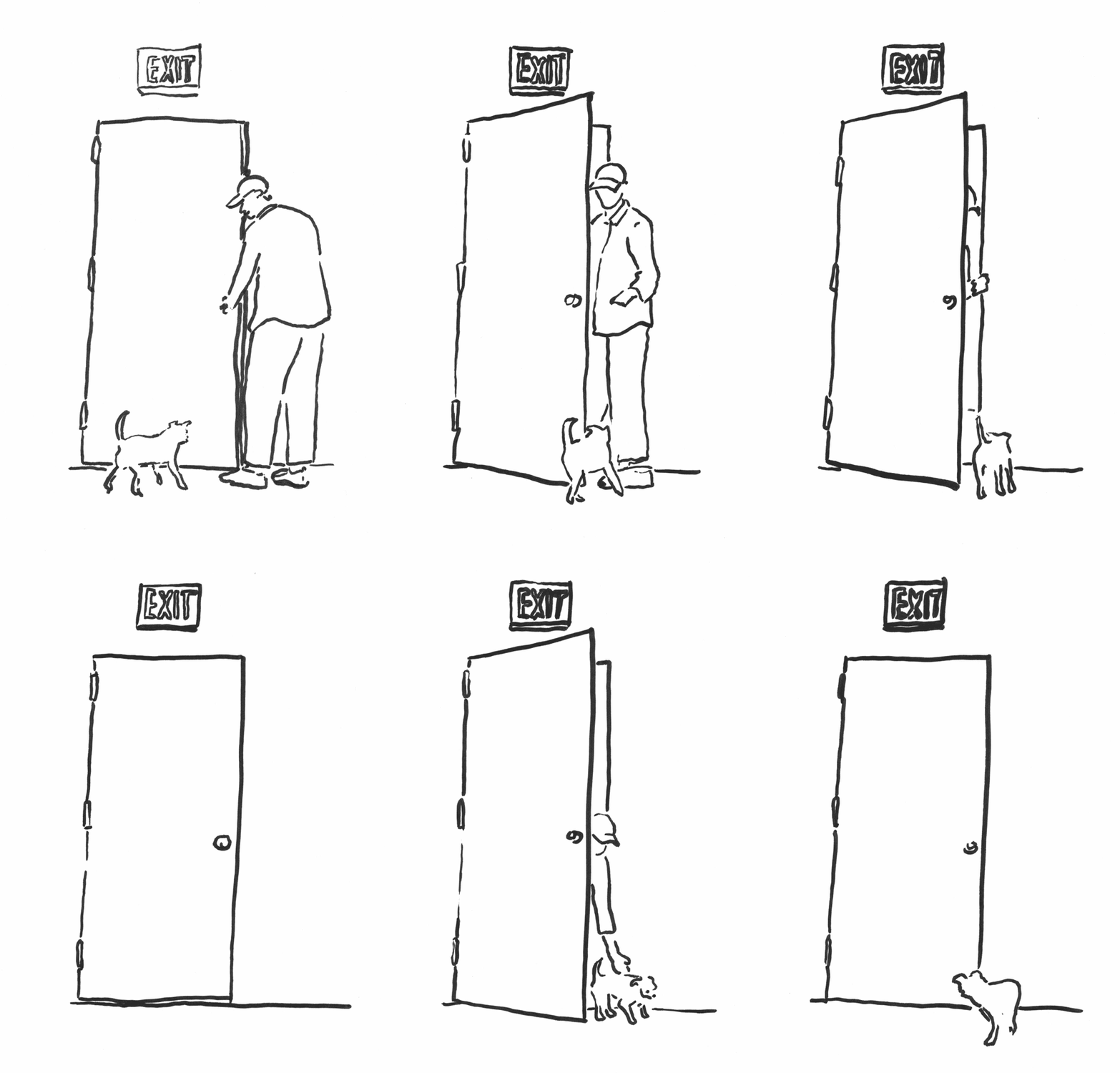
It was great hands-on practice and really got me thinking about the process of rotoscoping, and if it might be possible to cut computers (digital video, scanning, printing, photoshopping, etc.) out of that process altogether. Actually, I know for a fact that it’s possible, because Snow White was rotoscoped, and they didn’t have any computers back in the 30’s.
That thought leads me to the next thing I did in the studio today. A few nights ago Sam and I were watching Snow White, and I found it impossible to sleep afterwards. I went into an online rabbithole trying to figure out all the technical details of how the movie was made. One thing that really drove me crazy (still is driving me crazy, actually) was the lighting in the film. The shadows were transparent, and the lighting scenarios so realistic. The transparent shadows seemed to be painted on the same surface as the opaque figures– so they were painted on cels. My question is: how did they paint transparent shadows onto the cels? I have no idea what medium would look like that when painted/applied on a non-absorbant plastic surface like celluloid. This was truly keeping me up all night.
So, that sleepless night, I remembered that I had taken an animation class with Matthew Thurber at the beginning of the summer. Maybe he would know more about the materials used in animation productions of the 1930s. I sent him an email to set up a meeting this week, and that meeting took place today at 1. He did not know anything about the way the shadows in Snow White were done, but we did have a very interesting conversation about analog methods of rotoscoping. Seems like Disney had some sort of proprietary technology which streamlined that process, but anyone could make it work if you can figure out a way to project the film one frame at a time, instead of at speed. Matthew offered to let me try his Bolex camera + projector if I would just buy a roll of film. 16mm film costs $50 a roll, equal to 3 minutes of run time, but I really want to try this method– shooting an animation on film just seems so satisfying to me. It gives the movie a sort of materiality, like a painting, that a digital GIF or video just can’t accomplish. My plan now is to come up with a plan for a 3 minute long film, shoot the motion on one roll of 16mm film with the help of Matthew’s Bolex camera, project that + trace it in pencil, then create cels of the motion from that pencil test. Then I’ll have to get another roll of film to shoot the final frames of the animation. A roughly $100 budget for a totally analog 3 min long animated film isn’t too bad, I guess.
Somewhere in between my rotoscoping experiment and my fruitful conversation with Matthew Thurber, I also stretched a little 12” x 14” canvas. I made the frame a little while ago. Stretching the canvas only took 20 minutes or so because it was so little, but I did forget how to stretch the corners so I had to watch some Youtube videos to figure that out again. I also used my canvas pliers for the first time, so the canvas turned out nice and taut, like a drum. I didn’t get to gessoing it today beecause I don’t feel like it. I actually want to get some oil ground and try that on this little canvas, because the acrylic gesso is kind of gross and sucks up all my beautiful vibrant oil colors.
To recap:
Wrote screenplay for 15 min
Traced frames for rotoscope experiment
Made a GIF from rotoscope frames
Met with Matthew Thurber + came up with a plan for analog animation experiment
Made a 12” x 14” canvas but didn’t prime it
I’m happy with the outcome of today! Feeling excited for future projects. There will be no studio time tomorrow because my parents are coming into town and we are going to have an eventful day in the city. So, I’ll get back to work on Sunday! For now, time to watch some TV with Sam.
–Finn
