Reflections on Teaching Writing , 01/28/2026
January 28th, 2026
Writing is hard. And I say this as someone who teaches writing for a living! Let me tell you something: if you’ve ever thought writing is hard, I dare you to try and start teaching it. In my early classroom days I would often find myself preaching all kinds of techniques and step-by-step strategies that I hardly understood how to implement myself. It’s nearly impossible to explain where writing comes from, just like it’s nearly impossible to explain where a painting comes from. Techniques of creation are applied in various instinctive, intuitive ways by each individual, as a reaction and response to engagement with the materials at hand. The details of the process will always and forever be a secret between the writer and the page. At this point, I think that expression is a mysterious psychically-driven and energy-generating process, and I for one like it that way.
Alas, that framework is a bit difficult to apply to a traditional school setting. School demands clear instructions towards measurable results. I find that step-by-step guides towards a linear writing model seem appealing both to a student who is not yet confident in their writing abilities and a writing teacher who is not yet confident in her understanding of how writing actually works. It’s comforting to believe there is a set of ‘rules’ one can follow for consistent and successful outcomes. But that’s just the problem. Once a writer of any ability actually tries to start working in these predeterimend frameworks, they’re invariably disappointed by just how unsuccessful their work actually is. Essays written to earn a grade completely lack both life meaning. They are unbearably similar to each other no matter how different the student’s individual personalities, backgrounds, and interests may be. Boring to read and boring to write! Thus, writing seems extra hard, and extra pointless. But I think this is a school problem.
In an ideal world, I guess there would be no stakes of employment or economic survival attached to education. LaGuardia Community College students (who are often from underprivileged or immigrant backgrounds) face particularly high stakes in this regard, so it’s no wonder they’re all particularly anxious about ‘following the rules’. Not to mention the time crunch a semester inherently imposes. It just poses a problem for me as a teacher with abstract goals to help my students trust themselves, embrace individuality, and learn how to enjoy the process of hands-on exploration and self-expression. I think most of them just want to earn an A and get accepted into the school’s competitive nursing program. I hope they still take something away from my class as a happy, accidental discovery.
I do wish I had a good answer for my students when they asked me how to start a piece of writing. Usually I tell them that it doesn’t actually matter where or how you start writing as long as you do start– but anxious students don’t like that answer. The result more often than not is inaction or over dependence on AI tools, because the blank page is threatening. Maybe I’ll tell them to start by accepting the fear and uncertainty of the blank page. It’s always going to be there. I felt it when I started writing this blog post today, but now I’m chugging along. The way you start will always be different from how I start or how he starts– and none of us will even remember where we started once the piece is finished. That’s how it usually goes.
I guess I have no conclusion to these thoughts yet, but I wanted to put them down in some way because I was really beating myself up after what felt like a particularly unsuccessful class last night. I’m teaching the short 6-week session and everything feels so rushed. During the twelve-week session I can take a lot of time to read and discuss abstractly and a little more broadly. I have time to go off topic and explore a little bit, but it always comes back to action sooner or later.
This class is on their second essay assignment right now and I’m trying something new: a dream analysis research paper. It’s a pretty open prompt– choose a dream you’ve had, try to analyze what it means, and explain how you reached that conclusion. Since introducing the prompt, we’ve been analyzing some poems. I thought this would be useful way to ease into identifying and anlyzing imagery without having to get personal yet. Yesterday I introduced an article comparing Jung and Freud’s ideas of what dreams are and where they came from. I thought I was setting up some context for them to do a little bit of their own research and drawing their own conclusions, but this reading was really unpopular. It didn’t spark a lot of meaningful discussion, and after the reading, the class expressed frustration about not knowing where to start with this writing assignment. They actually all asked me to cancel it, because it was stressing them out so much.
It was embarrassing for me! I felt like I failed them– I failed to understand my audience. They could see that I was flustered, and I promised them I would restructure the rest of the semester to make this assignment more clear and approachable for them. I’m not going to cancel the assignment, because I actually believe it will be useful. I just need to find a way to show them how and why. That’s what I haven’t been able to really clearly express to them yet. We are going to write a film review paper first, then return to the dream analysis with a more hands-on approach.
So, ironically, I just got finished making a powerpoint presentation showing a more or less step-by-step template for how to write a film review. I tried to keep it simple and as open-ended as possible. We’re watching Shutter Island in class tomorrow (a dream related movie, of course… the context setting continues!) and their review of the film will be due Sunday, returning to the work of dream analysis next week. We’ll see how setting them up with that concrete film review framework influences the way they approach the more abstract prompt afterwards. I hope there is some sort of influence.
I haven’t even mentioned that I’m going to start teaching an Artist’s Way Reading Group starting this Sunday! I won’t get into it now, but I am very nervous. Needless to say, teaching and learning are on my mind. Audience is still on my mind too. Are students the best kind of audience?
Anyway, those are my ramblings about education for today. And this is supposed to be a studio blog. Trust me, the work is all connected somehow.
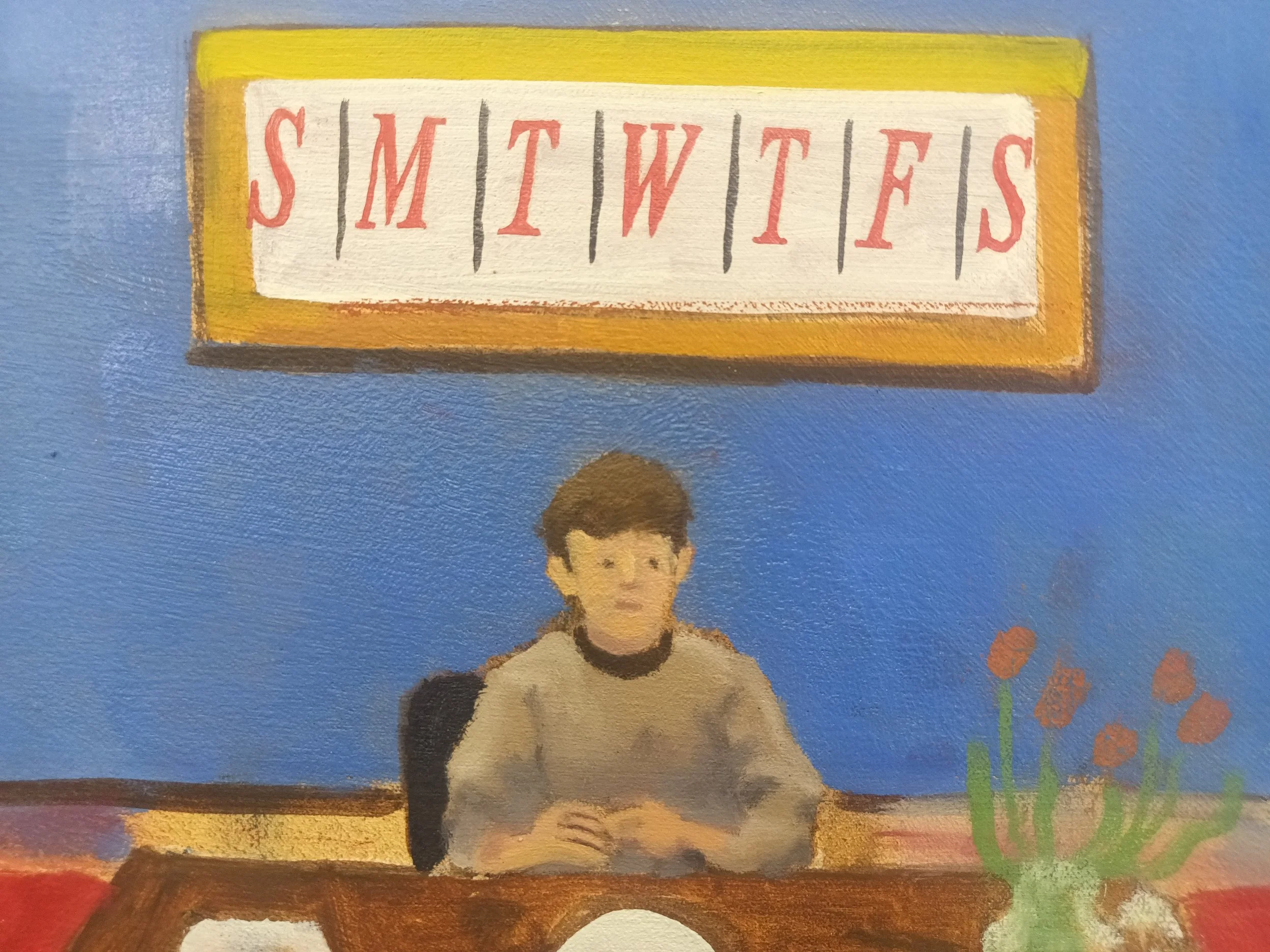
A little piece of a painting I’ve been working on about “time”. I’ll write about it later. Lol.
